What is a Steep Turn?
Steep turns consist of a single or multiple 360° turns in either or both directions, generally using a bank angle of 45° or 50° for training purposes. During the maneuver, pilots must maintain a constant altitude, airspeed, and bank angle.
When performing steep turns, pilots are exposed to:
- Higher load factors.
- The airplane’s inherent overbanking tendency.
- The need for additional power to maintain airspeed.
- The need for substantial pitch control pressures to maintain the vertical component of lift.
The Need for Additional Power in a Steep Turn
As an airplane is banked, back pressure on the pitch control is applied to maintain level flight. The increase in lift results in more drag and a slower airspeed.
The turn also increases the load factor and stall speed. Power must be increased to overcome drag and maintain a margin above the stall speed.
| Load Factor | Drag | Stall Speed | Power Required |
|---|---|---|---|
| Increases | Increases | Increases | Increases |
How to Perform a Steep Turn
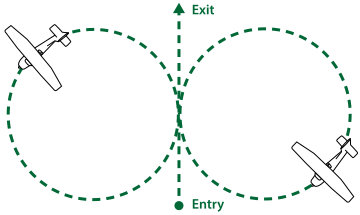
Pre-Maneuver Checks and Configuration
- Clear the area
- Heading established and noted:
- Select a suitable reference point on the horizon
- Align the heading bug, if equipped
- Altitude established:
- No lower than 1,500′ AGL [ASEL]
- No lower than 3,000′ AGL [AMEL]
- Position near a suitable emergency landing area and away from hazards
- Set power and aircraft configuration:
- Perform the clean (cruise) configuration flow
- Establish the recommended airspeed, or if not stated, an airspeed at or below VA or VO
Entry
- Note the pitch and power settings for use during the rollout.
- Smoothly and firmly apply aileron and rudder pressure in the direction of the desired turn.
- As the bank angle increases, apply back pressure to the pitch control to maintain level flight.
- Apply trim as desired to relieve control pressures.
- Add power as required to maintain airspeed.
Note: Trim may be used to relieve control pressures during steep turns. If used, anticipate forward pressure during rollout while removing trim to prevent ballooning.
Execution
- Maintain coordinated flight.
- Use the aileron to control the bank angle and counteract the overbanking tendency.
- Adjust power for airspeed deviations.
- Make small pitch and bank corrections for altitude deviations:
- If altitude decreases, momentarily reduce the bank angle by a few degrees.
- If altitude increases, momentarily increase the bank angle a few degrees.
Rollout
- Lead the rollout heading by approximately one-half the bank angle.
- Simultaneously level the pitch attitude and return power to the entry setting.
- Immediately roll into a turn in the opposite direction, if appropriate.
Exit
- Return to cruise attitude and airspeed.
- Retrim to relieve control pressures.
- Complete the cruise checklist.
Common Errors for Steep Turns
- Failure to scan for traffic before and during the maneuver
- Performing by reference to the flight instruments rather than visual references
- Inadequate pitch control on entry or rollout
- Failure to maintain a constant bank angle
- Gaining altitude in right turns and losing altitude in left turns when flown from the left seat
- Ineffective use of trim or power
- Rough or uncoordinated use of the flight controls
- Overcontrolling the airplane due to excessive or delayed flight control inputs
- Loss of orientation
- Failure to complete the turn on the designated heading or reference
Airman Certification Standards for Steep Turns
References: FAA-S-ACS-6, FAA-S-ACS-7, FAA-S-ACS-25, FAA-S-8081-29
Notes:
- For sport and private pilots, the number of 360° turns is specified by the evaluator. Commercial pilot and flight instructor certification requires two 360° turns in opposite directions.
- Steep turns are not considered “self-clearing.” A failure to clear the area is subject to disapproval.
| Airspeed | Altitude | Bank | Rollout |
|---|---|---|---|
| ±10 KIAS | ±100′ | 45° ±5° (SPT, PVT) 50° ±5° (COM, CFI) | ±10° |