Introduction
Short runways and obstacle-limited areas leave less room for imprecise airspeed control, delayed configuration, or unstable approaches. Pilots need to use special piloting techniques and planning to maximize performance and maintain a high margin of safety.
This lesson helps learners develop short-field takeoff and landing procedures, with emphasis on aircraft configuration, performance awareness, stabilized approaches, obstacle clearance, and precise touchdown control.
Objectives
After this lesson, learners will be able to:
- Describe the procedures for short-field takeoffs and landings.
- Describe a stabilized approach and energy management concepts.
- Explain the effects of atmospheric conditions on takeoff and landing performance.
- Explain the appropriate airplane configuration for short-field operations.
- Complete the appropriate checklists and make proper radio calls.
Prerequisite Lessons
Tips for Instructors
- Instead of saying, "Show me a short-field takeoff and landing," create a realistic scenario that requires the learner to use short-field techniques.
- If the airport does not have an actual short runway, denote a portion to use as a short runway.
- Learners should be familiar with the formulas and rules of thumb for reducing the published approach speed for lower operating weights. However, pilot testing standards require the applicant to maintain the manufacturer's published approach airspeed.
Lesson Briefing
- What is a Short-Field Takeoff?
- How to Perform a Short-Field Takeoff
- Engine and Instrument Checks During Takeoff
- Takeoff Performance
- Safety Considerations for Short-Field Takeoffs
- Common Errors for Short-Field Takeoffs
- Airman Certification Standards for Short-Field Takeoffs
- What is a Short-Field Landing?
- Stabilized Approach Concept
- Aiming Point Versus Touchdown Point
- Pitch and Power Control
- How to Perform a Short-Field Landing
- Landing Performance
- Safety Considerations for Short-Field Landings
- Common Errors for Short-Field Landings
- Airman Certification Standards for Short-Field Landings
- Risk Examples for Airport Operations
Appendices and Supplements
Aircraft Specific Training
- Procedures, precautions, and performance charts in the AFM/POH
- Checklist items and V-speeds
Scenarios
Scenario 1: Short Runway with Obstacles
You are taking a friend to a rural airport with a short paved runway, light and variable winds, and an afternoon temperature of 90°F. Trees near the approach and departure path require precise performance planning, configuration, airspeed control, and touchdown point management before deciding whether the flight can be made safely.
Case Studies
N97119, Mooney M20K: Short-Runway Takeoff Accident
- A Mooney collided with a fence and berm after failing to achieve expected takeoff performance on a 1,953-foot runway.
- Lesson Connection: Takeoff-performance planning and establishing a predetermined abort point
- NTSB Report: https://web.ntsb.gov/investigations/?ntsbnumber=WPR16FA095
Resources
- Airplane Flying Handbook (FAA-H-8083-3):
- Chapter 6: Takeoffs and Departure Climbs
- Chapter 9: Approaches and Landings
- Aeronautical Information Manual (AIM):
- 4-3-4: Visual Indicators at Airports Without an Operating Control Tower
- 4-3-10: Intersection Takeoffs
- 4-4-15: Use of Visual Clearing Procedures and Scanning Techniques
- 7-6-8: Use of Runway Half-way Signs at Unimproved Airports
- AC 91-79: Aircraft Landing Performance and Runway Excursion Mitigation
- AOPA Video: Takeoffs and Landings: Short Field Landings (https://youtu.be/XR3NWSN9nb8)
Schedule
- Lesson Briefing (0:45)
- Demonstrations and Practice (0:40)
- Lesson Debriefing (0:15)
Equipment
- Digital presentation tools or a whiteboard with markers and erasers
- Reference books and materials
- Spare notepads, pens, and highlighters
- Airplane models
- Airplane checklists
- Headsets and flight gear
Lesson Debriefing
- Conduct a collaborative assessment focused on the objectives.
- Address remaining learner questions and areas of uncertainty.
- Provide feedback on strengths and areas needing further study.
Completion Standards
- The lesson objectives are met
- The learner's performance is appropriate to the stage of training
- Ultimately, the learner must meet the applicable Airman Certification Standards
Lesson Content
What is a Short-Field Takeoff?
Short-field takeoff procedures are used when operating from a runway of limited length or when obstacles restrict the available takeoff distance. These operations require precise control, proper configuration, and maximum performance from the airplane.
How to Perform a Short-Field Takeoff

Setup
- Set flaps as recommended and complete the before-takeoff checklist.
- Assess wind conditions and position the flight controls accordingly.
- Verify the correct runway by checking markings, signage, and heading.
- Obtain the appropriate clearance or ensure the area and approach path are clear.
- Taxi into position using the maximum available runway length.
- Align the airplane with the runway centerline and confirm heading alignment.
Takeoff Roll
- Apply the brakes to hold the airplane stationary.
- Smoothly apply full power and verify full power is being produced.
- Ensure engine temperatures and pressures are in their normal ranges (in the green).
- Release the brakes and maintain directional control with the rudder.
- Check for "airspeed alive".
- Maintain alignment with the runway centerline using outside visual references.
- Use appropriate aileron input for crosswind conditions.
Liftoff
- At the recommended liftoff speed, apply back pressure to raise the nose to the specified takeoff attitude, using more aggressive input than during a normal takeoff.
- Maintain directional control with the rudder.
- Establish a pitch attitude that accelerates the airplane to and maintains VX.
Maximum Performance Climb
- Maintain VX until obstacles are cleared.
- After clearing obstacles, transition to VY.
- Retract the landing gear, if retractable, and flaps in the recommended sequence.
- Maintain coordinated flight with proper control inputs.
- Maintain takeoff power and appropriate climb speed until reaching a safe maneuvering altitude.
- Complete the climb checklist.
Engine and Instrument Checks During Takeoff
Note: Static (motionless) RPM ranges at full power are published in Type Certificate Data Sheets (TCDS). These ranges give the pilot of a fixed-pitch propeller airplane an RPM indication to expect during the initial takeoff roll. However, these values were determined under standard atmospheric conditions at sea level.
- "Power Set":
- With a fixed-pitch propeller, RPM starts below the red line but increases as the airplane accelerates.
- With a constant-speed propeller, the tachometer should read within 40 RPM of the red line as soon as full power is applied. Manifold pressure will roughly equal atmospheric pressure with a normally aspirated engine.
- "T&P's in the Green": Engine temperatures and pressures should be in their normal ranges.
- "Airspeed Alive": Check the airspeed indicator for proper operation. Indications typically begin as the airplane accelerates through 20–30 knots.
Takeoff Performance
References: AIM 4-3-10, AIM 7-6-7
The most critical conditions of takeoff performance are combinations of:
- High gross weight
- High-density altitude
- Contaminated runways
- Tailwinds
- Uphill slopes
- Short runways
Rules of thumb:
- 50/70 Rule: Abort the takeoff if no more than 70% of the takeoff speed is reached by 50% of the runway length.
- 50/50 Rule: As a safety margin, add 50% to the planned takeoff distance over a 50-foot obstacle.
Wind
Rules of thumb:
- A headwind of 10% of the takeoff airspeed reduces takeoff distance by about 19%.
- A headwind of 50% of the takeoff airspeed reduces takeoff distance by about 75%.
- A tailwind of 10% of the takeoff airspeed increases the takeoff distance by about 21%.
Density Altitude
An increase in density altitude:
- Requires a greater takeoff speed (same IAS but TAS is higher than at sea level).
- Decreases acceleration due to decreased thrust.
Safety Considerations for Short-Field Takeoffs
- Use the AFM/POH performance data to determine proper configuration, speeds, and procedures.
- Maintain precise airspeed control; small deviations can significantly reduce climb performance.
Common Errors for Short-Field Takeoffs
Setup:
- Failure to review the AFM/POH and performance data before takeoff
- Failure to set flaps as recommended
- Failure to clear the area before taxiing into position
- Failure to align the airplane with the runway centerline
- Failure to use the maximum available runway length
- Failure to hold the brakes until full power is applied and engine indications are checked
Takeoff Roll:
- Applying power abruptly
- Failure to check engine indications after takeoff power is applied
- Failure to anticipate left-turning tendencies during initial acceleration
- Using brakes to assist with directional control during the takeoff roll
- Removing the hand from the throttle
- Fixating on the airspeed indicator
Liftoff:
- Failure to establish the proper liftoff attitude
- Lifting off prematurely, resulting in excessive drag
- Continuing the takeoff roll after liftoff speed is reached
- Dropping the left wing after liftoff due to inadequate rudder pressure or a limited visual scan
Maximum Performance Climb:
- Failure to compensate for torque and P-factor, resulting in a sideslip
- Failure to maintain the best angle-of-climb airspeed (VX)
- Chasing the airspeed indicator instead of using attitude flying principles
- Fixating on the airspeed indicator during the initial climb
- Retracting the landing gear or flaps prematurely
- Failure to complete the appropriate checklist
Airman Certification Standards for Short-Field Takeoffs
References: FAA-S-ACS-6, FAA-S-ACS-7, FAA-S-ACS-25, FAA-S-8081-29
Obstacle Clearance Speed:
- SPT and PVT: Recommended airspeed, or VX, +10/-5 knots, until the obstacle is cleared, or 50' AGL
- COM and CFI: Recommended airspeed, or VX, +5 knots, until the obstacle is cleared or 50' AGL
Climb Speed:
- SPT and PVT: Accelerate to and maintain VY, +10/-5 knots to a safe maneuvering altitude
- COM and CFI: Accelerate to and maintain VY, ±5 knots to a safe maneuvering altitude
What is a Short-Field Landing?
Short-field landing procedures are used when operating into a runway of limited length or when obstacles restrict the approach. These landings require precise control, a stabilized approach, and an accurate touchdown to achieve the shortest landing distance.
Stabilized Approach Concept
Reference: FAA Fact Sheet – Stabilized Approach and Landing
A stabilized approach is one in which the airplane follows a constant glidepath toward a selected aiming point while maintaining a consistent airspeed and configuration.
A stabilized approach provides:
- More time to monitor communications and make decisions.
- Defined support for deciding to land or to go around.
- Landing performance consistent with published performance.
Aiming Point Versus Touchdown Point
An airplane descending on final approach at a constant rate and airspeed travels in a straight line towards a spot on the ground ahead, commonly called the aiming point.
To the pilot, the aiming point appears to be stationary. It does not appear to move up or down on the windscreen. Objects in front of and beyond the aiming point appear to move as the distance is closed, and they appear to move in opposite directions.
If the airplane maintains a constant glidepath without flaring, it will strike the ground at the aiming point. However, the airplane will not touch down at the aiming point because it will float.

Taking into account float during the round out, the pilot can predict the touchdown point within a few feet. The actual location of the touchdown should be approximately 1,000' down the runway and within the first third of the runway.
Pitch and Power Control
Pilots control airspeed and altitude through a combination of pitch and power (thrust) adjustments. Through experience, pilots learn to lead with the control that offers the most responsiveness, making their flying more precise.
Power Conditions
All phases of flight fall into two basic power conditions: fixed-power and adjustable-power. An adjustable-power condition exists when power is both variable and available. In all other situations, power remains constant (fixed) either by choice or due to an engine failure.

Fixed-Power Conditions
Most phases of flight occur at a fixed power setting. With power fixed, the pitch control manages altitude, airspeed, or vertical speed (climb or descent rate), as appropriate.
Examples of fixed-power conditions:
- Cruise Flight: Pitch controls altitude.
- Climbs and Descents: Pitch controls airspeed or vertical speed, as desired.
- Power-Off Glide: Pitch controls airspeed.
- Traffic Pattern: Pitch controls altitude on downwind. If power is fixed in the descent, pitch controls airspeed (techniques may vary).
Although small, occasional power adjustments may be needed in these phases of flight, power is still considered "fixed."
Adjustable-Power Conditions
The pitch control adjusts the flight parameter that requires the quickest response and most precision. The airplane responds quickly to pitch control inputs because the AOA on the elevator (or stabilator) changes instantly. Adjusting power generally takes longer to have a noticeable effect, especially with turbine engines, which take several seconds to spool up.
Examples of adjustable-power conditions:
- Instrument Approach (All Airplanes): Pitch controls vertical speed and glidepath. Power controls airspeed.
- Visual Approach and Landing (Small Airplanes):
- Option One: Pitch controls vertical speed. Power controls airspeed.
- Option Two: Pitch controls airspeed. Power controls vertical speed.
- Maneuvering During Slow Flight: Pitch controls airspeed. Power controls altitude.
- General Maneuvering: Pitch controls altitude. Power controls airspeed.
Trade-Offs
Some situations can be corrected with a trade-off (exchanging altitude for airspeed and vice versa). For example, if the airplane is both high and slow, the pilot can leave the power alone and pitch down.
The Effect of Pitch and Power Changes During an Approach
The following table describes the effect of moving a single control (pitch or power) during an approach to a landing.
| Control Input | Energy Effect | The Airplane Moves |
|---|---|---|
| Increase power | More total energy | Higher and faster |
| Decrease power | Less total energy | Lower and slower |
| Increase pitch | Same total energy; Speed is traded for height | Higher but slower |
| Decrease pitch | Same total energy; Height is traded for speed | Lower but faster |
Key Takeaways:
- The movement of a single control affects both speed and glidepath.
- Power primarily changes the total energy (speed and height), while pitch changes the distribution of that energy ("trade-offs").
- To change only speed or altitude, a mix of pitch and power inputs is required. The right blend of both cancels out the undesirable change.
- Large deviations from the desired speed and/or glidepath require a combination of inputs.
The "Pitch Versus Power" Debate
Small reciprocating engines respond quickly to power inputs, so there is little difference in the response times of the pitch and power controls. This opens the door to debate over which control should be used to manage airspeed, especially during a visual approach and landing.
Considerations for choosing a technique:
- Beginning pilots can be overwhelmed by "too much information." They should not have to question what applies in a given situation.
- FAA handbooks recommend using pitch to control airspeed while maneuvering during slow flight (in the region of reversed command). An energy management matrix is provided for approaches and landings.
- During stall training, learners are taught to immediately lower the AOA by lowering the pitch (pitch controls airspeed).
- Autopilots maintain the glidepath using pitch controls during an approach. Auto-throttles monitor and control airspeed.
- Large and turbine-powered airplanes require a specific technique (power controls airspeed) because of their inertia and slow power response.
How to Perform a Short-Field Landing
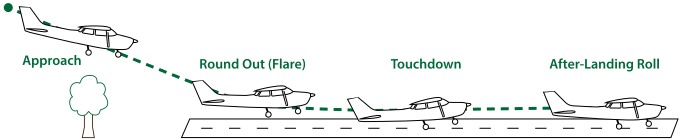
Setup
- Assess wind conditions and determine crosswind components.
- Enter the traffic pattern as directed by ATC or using a standard entry.
- Maintain recommended airspeed on downwind (typically about 1.5 VS0).
- Evaluate the landing area, including obstacles and available runway length.
- Identify a suitable touchdown point.
- Complete the before-landing checklist.
Approach
- Abeam the touchdown point:
- Reduce power.
- Extend flaps and landing gear, if equipped, as recommended.
- Begin descent and trim as necessary.
- Adjust the downwind spacing as needed to allow a stabilized final approach.
- Turn base as required based on wind, altitude, and spacing.
- Maintain recommended airspeed (typically about 1.4 VS0).
- Extend additional flaps as required.
- Lead the turn to final to align with the runway centerline.
- Maintain a stabilized approach at the recommended airspeed (typically not more than 1.3 VS0).
- Use a steeper descent angle as required to clear obstacles.
Round Out (Flare)
- Begin the round out at the appropriate height above the runway to achieve the desired touchdown point.
- Gradually increase back pressure to transition to a landing attitude.
- Maintain directional control with the rudder.
- Use minimal power as needed to control the rate of descent.
Touchdown
- Touch down on the main wheels at the minimum controllable airspeed at the selected touchdown point.
- Maintain alignment with the runway centerline and eliminate drift.
- Hold the nosewheel off until both main wheels are on the ground.
After-Landing Roll
- Apply maximum braking as required while maintaining directional control.
- Apply back pressure to increase aerodynamic braking.
- Retract flaps on rollout if recommended by the manufacturer.
- Increase crosswind control inputs as the airplane slows.
- Slow to a safe taxi speed before turning off the runway.
- Clear the runway and complete the after-landing checklist.
Landing Performance
References: 14 CFR 91.1037, 14 CFR 121.195, 14 CFR 135.385, AC 91-79
The most critical conditions of landing performance are combinations of:
- High gross weight
- High-density altitude
- Contaminated runways
- Tailwinds
- Downhill slopes
- Less than maximum landing flaps
- Short runways
Rules of thumb:
- Increase the landing distance by 50% for a wet runway.
- Increase the approach speed by 20% if ice is on the wings.
- For every knot above the recommended approach airspeed at the runway threshold, the touchdown point is 100' further down the runway.
Aerodynamic Drag
Aerodynamic drag can be used early in the landing roll. Unlike wheel brakes and tires, which suffer continuous hard use, aerodynamic drag is free and doesn't wear out.
Aerodynamic drag is most beneficial for decelerating to 60% to 70% of touchdown speed. At slower speeds, aerodynamic drag becomes less effective. Wheel braking must increase to continue deceleration.
Weight
The minimum landing distance varies directly with gross weight. A higher gross weight requires a faster approach speed and more effort to decelerate to a stop after landing.
A 10% increase in gross weight causes:
- An estimated 5% increase in landing velocity.
- An estimated 10% increase in landing distance.
Density Altitude
Approach Speed: Higher density altitude increases landing speed. At altitude, the aircraft lands at the same IAS as at sea level, but TAS is greater because of the reduced density.
Visual Cues: Because a given IAS corresponds to a higher TAS at higher density altitudes, pilots are sometimes "tricked" by visual cues and fly slower than they should.
Landing Distance: The approximate increase in landing distance with altitude is approximately 3.5% for each 1,000' of altitude. At 5,000', the required landing distance is 16% greater than at sea level.
Excessive Airspeed and Wind
Excessive speed upon touchdown:
- Places a greater load on the brakes because of the additional kinetic energy.
- Increases lift in the normal ground attitude after landing, which reduces braking effectiveness.
An airplanes's stopping distance (assuming the same braking force) is directly proportional to its kinetic energy. If the kinetic energy quadruples, the stopping distance also quadruples.
Example: An airplane on the runway moving at 75 knots has four times the energy it has when moving at 37 knots. The airplane requires four times as much distance to stop.
Rules of thumb:
- A 10% increase in approach speed increases the landing distance by 20%.
- For every 10 knots of tailwind, increase the landing distance by at least 21%.
Approach Speed Calculations
Sometimes variations in the normal approach speed should be made to compensate for changes in weight and gusty wind conditions.
Normal Approach Speed: If the manufacturer does not recommend an approach airspeed, 1.3 VS0 should be used.
 Example Calculation:
58 VS0 × 1.3 = 75 KIAS
Variations in Weight: Manufacturers typically publish the approach speed at the airplane's maximum gross weight. The approach speed for a lower operating weight can be approximated with the following formula; however, the manufacturer's published speeds and recommendations should be followed.
VREF1 = VREF2 × √(Current Weight ÷ Maximum Gross Weight)
- VREF1 is the calculated approach speed for the current weight.
- VREF2 is the AFM/POH approach speed at the maximum gross weight.
 Example Calculation:
2,000 Actual Weight ÷ 2,500 Gross Weight = .80
√.80 = .894
75 KIAS X .894 = 67 KIAS
Wind Gust Factor: Slightly higher-than-normal airspeeds provide more positive control during strong horizontal wind gusts. One procedure is to use the normal approach speed plus one-half of the wind gust factor.
 Example Calculation:
"Wind 180° at 10 knots gusting to 20 knots."
½ of the 10 knot gust factor = 5 KIAS
67 + 5 = 72 KIAS
Safety Considerations for Short-Field Landings
- Maintain a stabilized approach and proper airspeed control.
- Plan to be established on final approach approximately 500' above the touchdown point to ensure a stabilized descent.
- Use coordinated pitch and power adjustments when operating near minimum airspeeds.
- Time the round out accurately to avoid hard landings or excessive sink.
- Avoid reducing power too early in the flare.
- Verify the runway is clear of traffic and obstructions before landing.
- Use caution when retracting flaps on rollout to avoid selecting the landing gear.
Common Errors for Short-Field Landings
Setup:
- Failure to complete the appropriate checklist
- Improper use of landing performance data
- Failure to establish the proper configuration at the appropriate time
- Inadequate evaluation of obstacles and landing distance
Approach:
- Failure to correct for wind drift
- Improper base-to-final turn
- Failure to account for flap extension
- Failure to maintain a stabilized approach
- Failure to recognize the need for a go-around/rejected landing
- Improper descent angle or energy management
- Reducing power too early after clearing obstacles
Round Out (Flare):
- Removing the hand from the throttle
- Attempting to control descent using pitch alone
- Flaring too high or too late
- Excessive or insufficient airspeed affecting flare effectiveness
Touchdown:
- Failure to touch down at the selected point
- Failure to maintain alignment with the runway centerline
- Touching down in an improper landing attitude
- Allowing excessive sink rate at touchdown
- Releasing control pressure after touchdown
After-Landing Roll:
- Failure to maintain directional control
- Failure to apply effective braking
- Improper brake application resulting in loss of control
- Attempting to turn before slowing to taxi speed
- Improper configuration changes after touchdown
Airman Certification Standards for Short-Field Landings
References: FAA-S-ACS-6, FAA-S-ACS-7, FAA-S-ACS-25, FAA-S-8081-29
Approach Speed:
- SPT and PVT: As recommended, or in its absence, not more than 1.3 VS0, +10/-5 knots with gust factor applied
- COM and CFI: As recommended, or in its absence, not more than 1.3 VS0, ±5 knots with gust factor applied
Touchdown Point:
- SPT and PVT: At a proper pitch attitude within 200' beyond or on the specified point, with no side drift, minimum float, and with the airplane's longitudinal axis aligned with and over the center of the runway
- COM and CFI: At a proper pitch attitude, within 100' beyond or on the specified point, with no side drift, minimum float, and with the airplane's longitudinal axis aligned with and over the center of the runway
Notes:
- 200' is the typical length of one centerline stripe (120') and a gap (80').
- 100' is shorter than the typical length of one centerline stripe (120').
Risk Examples for Airport Operations
Collision Hazards Related to Airport Operations
- High-density traffic at a nontowered airport increases the likelihood of midair collisions; remain alert, clear the area before turning, and make radio calls.
- Simultaneous operations on parallel or intersecting runways increase the risk of runway incursions and collisions; maintain situational awareness and comply with ATC instructions or make radio calls.
- Incorrect traffic pattern entry procedures can cause conflicts with aircraft already in the pattern; follow standard traffic pattern entry procedures.
Low-Altitude Maneuvering, Including Stall, Spin, or CFIT
- Power lines, towers, and rapidly rising terrain increase the potential for CFIT; avoid unnecessary maneuvers near the ground.
- Lack of airspeed or altitude awareness can lead to inadvertent CFIT, stall, spin, or loss of control; increase focus and awareness as altitude or airspeed decreases.
Distractions, Task Prioritization, Loss of Situational Awareness, or Disorientation
- Distractions, poor task prioritization, loss of situational awareness, or disorientation can cause delayed, omitted, or incorrect actions; minimize nonessential tasks, prioritize "Aviate, Navigate, Communicate," and remain focused.
Windshear and Wake Turbulence During Takeoffs and Landings
- Windshear can rapidly change airspeed and flightpath and lead to loss of control; avoid reported or detected windshear and execute the approved escape guidance promptly if encountered.
- Wake turbulence can result in a loss of control; maintain safe separation from preceding aircraft.
Selection of Runway for Takeoffs and Landings
- Runway length may be inadequate for a safe takeoff or landing; select the most suitable runway based on preflight performance planning.
- Soft or uneven runway surfaces can reduce performance; account for surface condition during preflight performance planning.
- Wind direction can present crosswind challenges or tailwind landings; select the most suitable runway based on the current winds.
- Obstacles pose a collision risk; ensure a clear departure or approach path.
Effects of the Environment and Runway Surface/Condition
- Crosswind can make it difficult to maintain directional control and may cause runway excursions; apply appropriate crosswind correction techniques.
- Windshear can result in loss of control and increased takeoff or landing distance; avoid reported or detected windshear and execute the approved escape guidance promptly if encountered.
- A tailwind increases takeoff and landing distance and can reduce runway margins; select an into-wind runway when practical and apply published tailwind limitations and performance data.
- Wake turbulence can result in a loss of control; maintain safe separation from preceding aircraft.
- Surface conditions can make it difficult to maintain directional control or increase takeoff or landing distance; ensure the runway surface is suitable.
Planning for Abnormal Operations During Takeoff
- Failure to plan for a rejected takeoff can result in a delayed response and runway excursions; review and brief emergency procedures before takeoff.
- Failure to plan for an engine failure after liftoff can lead to a delayed response, loss of control, and an inability to make a safe landing; brief the engine-failure response before takeoff.
Planning for Abnormal Operations During Landing
- Failure to plan for a go-around or a rejected landing can result in a delayed response, loss of control, and becoming too low or too slow to conduct a safe go-around; stay vigilant and prepared to execute a go-around or a rejected landing.
- Failure to plan for LAHSO increases the likelihood of conflicts and pilot deviations; calculate the required landing distance and ask for extra time if necessary.
Stabilized Approach Criteria
Stabilized Approach Concept
A stabilized approach is characterized by a constant-angle, constant-rate of descent approach profile ending near the touchdown point, where the landing maneuver begins. Slight and infrequent adjustments are all that are needed to maintain a stabilized approach.
Stabilized Approach Criteria
C-FLAPS
- Checklists and briefings: Complete
- Flightpath: Established (±1 dot of deflection horizontally and vertically)
- Landing Configuration: Set
- Airspeed: Established (+10/-5 knots)
- Power: Set for the airplane configuration
- Sink Rate: No greater than 1,000 FPM
Notes:
- These parameters should be adjusted for the aircraft type and include all manufacturer guidance.
- Any approach that requires deviations from the parameters should be addressed in a special briefing.
Minimum Stabilization Heights
The recommended minimum stabilization heights are:
- 300' above the airport elevation in VMC for a small airplane in the traffic pattern.
- 500' above the airport elevation in VMC.
- 1,000' above the airfield elevation in IMC.
- For a circling approach, MDA or 500' above the airport elevation, whichever is lower.
Go-Around for Safety
The objective is to stabilize the aircraft before reaching the predetermined minimum stabilization height. If the aircraft is not stabilized at the minimum stabilization height or becomes unstabilized below it, a go-around should be initiated.
Reference: AC 61-98
Energy Management Matrix
| Too Slow | Desired Speed | Too Fast | |
|---|---|---|---|
| High | Exchange energy by pushing the pitch control forward to accelerate and descend simultaneously. Maintain the power setting. | Reduce the power setting to reduce total energy. Use the pitch control to maintain the correct airspeed and descend. | Reduce the power setting significantly to decrease total energy. Pull back on the pitch control gradually to decelerate to the correct airspeed and then descend. |
| Desired Altitude or Glidepath | Increase the power setting to gain total energy by accelerating. Use the pitch control to maintain the desired altitude. | DESIRED ENERGY STATE Maintain the power setting and pitch attitude. Trim to relieve control pressures. | Reduce the power setting to decelerate. Use the pitch control to maintain the desired altitude. |
| Low | Increase the power setting significantly to gain total energy. Push the pitch control forward gradually to accelerate to the correct airspeed and then climb. | Increase the power setting to gain altitude and pull back on the pitch control to maintain the correct airspeed. | Exchange energy by pulling back on the pitch control to climb and decelerate simultaneously. Maintain the power setting. |