Effects of Human Behavior and Communication on the Learning Process
Definitions of Human Behavior
Human behavior can be defined in many ways:
- The result of attempts to satisfy certain needs.
- The product of factors that cause people to act in predictable ways.
- A distinct set of physical, physiological, and behavioral features associated with each phase of life.
Instructors study human behavior to understand how individuals act, react, and interact within their environment. This knowledge reveals learner motivation and allows instructors to tailor instruction to optimize learning.
The Instructor-Learner Relationship
The professional relationship between the instructor and the learner should be based on a mutual acknowledgment that both are important to each other and are working toward the same objective.
Core Principles of the Instructor-Learner Relationship
Fairness: Instructors should not treat learners unfairly or favor some over others.
Consistency: Instructors should be steady in their actions, principles, and performance standards.
Approachability: Instructors should be approachable and accessible, but not necessarily friends. Certain boundaries must not be overstepped.
Best Practices for Building Professional Relationships
- Add Value: Go in to give, not to receive.
- Be Positive: Show respect and portray a positive attitude.
- Be Authentic: Be open about your goals and mistakes.
- Attend: Listen actively and show interest.
- Give Praise: Recognize effort and progress, no matter how small.
- Show Empathy: Put yourself in their shoes.
- Adapt: Consider the learner's personality and preferred learning style.
Motivation
Motivation is the drive that directs learners toward goals and sustains the effort needed to achieve them.
Types of Motivations
Obvious or Subtle: Direct and easily recognizable or more understated.
Positive or Negative: Positive motivation comes from rewards, while negative motivation involves fear or threats, which is useful for addressing unsafe practices.
Tangible or Intangible: Physical rewards like money or non-physical rewards like satisfaction.
Intrinsic or Extrinsic: Intrinsic motivation is driven by internal desires, while external rewards or pressures influence extrinsic motivation.
Methods of Maintaining Motivation
To help maintain learner motivation, instructors should:
- Present new challenges.
- Acknowledge and praise incremental achievements.
- Create a need to learn the material ("What's in it for me?").
Using Praise as a Motivator
Praise is the expression of approval. It stimulates the brain's reward and pleasure centers and provides valuable feedback to learners.
Tips for instructors:
- Comment favorably on learner progress.
- Connect daily achievements to the lesson objectives.
- Focus on the process rather than ability (e.g., Instead of saying, "You are a natural pilot," say, "I can tell you prepared.").
Kind words can be short and easy to speak, but their echoes are truly endless.
Mother Teresa
Using Rewards as Motivators
Rewards can motivate learners with low interest in a subject, but their effect is often short-lived and doesn't boost intrinsic motivation.
Rewards may demotivate learners if they feel it is being used to control their behavior, or if the subject is intrinsically motivating and the reward is known beforehand.
Tips for instructors:
- Seek alternatives that are more intrinsic.
- Use rewards only for a limited time and a specific purpose.
Overcoming Drops in Motivation
Drops in motivation can manifest in various ways, such as learners arriving unprepared or showing diminished commitment to aviation training.
To boost motivation, instructors should:
- Explain that learning seldom proceeds at a constant pace.
- Reinforce learners' initial goals for pursuing aviation training.
- Assure learners that learning plateaus are normal and that improvement will resume with continued effort.
Human Needs and Motivation
Human needs are the things humans require for normal growth and development. These needs can be basic, such as the need for food and water, or more complex, such as recognition and acceptance.
Maslow's Hierarchy of Human Needs
Abraham Maslow developed a pyramid-style model to illustrate human motivations and needs. This model organizes motivations into distinct levels. As individuals fulfill the requirements of one level, they aspire to the next.
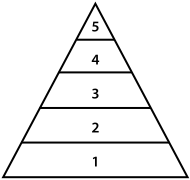
Physiological (1): The need for air, food, and water, and the maintenance of the human body.
Safety and Security (2): The need to avoid pain and injury.
Love and Belonging (3): The need for social approval. This involves love, affection, and a sense of belonging.
Esteem (4): The need for self-respect and respect from others. When met, the person feels self-confident and valuable. When unmet, the person feels inferior, helpless, and worthless.
Self-Actualization (5): The desire to maximize one's abilities. Maslow described it as "the desire to become more and more what one is, to become everything that one is capable of becoming."
Self-actualized people are characterized by:
- Having a deep concern for personal growth.
- Not being afraid of the unknown; rather, they embrace it.
- Incorporating an ongoing freshness of appreciation of life.
Needs Added in Later Years by Maslow
Cognitive: The desire to know and understand. When learning occurs, the brain reinforces this need by releasing dopamine, resulting in a sense of reward.
Aesthetic: The desire for things around the person to be aesthetically pleasing. Aesthetics can enhance positive motivation and contribute to a successful learning experience.
Transcendence: Needs that extend beyond one's self, such as engaging in acts of service, pursuing scientific endeavors, or expressing faith.
Bodily Reward Systems
Basic Needs: Meeting basic human needs brings about a sense of satisfaction, also known as satiation. For example, hunger motivates someone to eat. Once the need is fulfilled, motivation decreases.
Growth Needs: Complex motivations, such as the desire for personal achievement, are rewarded by dopamine release in the brain. As growth needs are satisfied, motivation increases.
Instructor Responsibilities Relating to Human Needs
Learner Readiness: Instructors should confirm that learners' fundamental needs are met before commencing a lesson.
Learning Environment: A conducive learning environment minimizes frustrations for learners, enabling them to focus more effectively.
Defense Mechanisms
Defense mechanisms are subconscious reactions that help a person cope with anxiety arising from unpleasant situations. The reactions can be biological (due to fear) or psychological (due to unacceptable thoughts or feelings).
Defense mechanisms:
- Inhibit learning.
- Operate on an unconscious level.
- Distort, transform, or falsify reality.
- Alleviate symptoms, not causes.
A perceptive instructor can identify defense mechanisms and help a learner by discussing the problem. The goal should be to restore motivation and self-confidence.
Biological Defense Mechanisms
Biological defense mechanisms are physiological responses that protect or preserve life. They develop when adrenaline or other chemicals are released, causing physical symptoms such as a rapid heart rate and elevated blood pressure.
Psychological (Ego) Defense Mechanisms
Psychological defense mechanisms are unconscious mental processes to shield from anxiety and negative emotions. People use these defenses to prevent unacceptable ideas or impulses from entering the conscious mind.
Types of Psychological Defense Mechanisms
Denial: Refusing to admit the existence or truth about something.
Repression: Restraining thoughts or emotions by placing them into inaccessible areas of the mind.
Displacement: Putting unpleasant feelings somewhere other than where they belong (taking anger out on someone else).
Rationalization: A subconscious technique for justifying actions that otherwise would be unacceptable.
Compensation: Counterbalancing weaknesses by emphasizing strengths in other areas.
Projection: Blaming personal shortcomings, mistakes, and transgressions on someone else.
Reaction Formation: When a person fakes a belief opposite to the actual belief because the actual belief causes anxiety.
Fantasy: When a learner engages in daydreams about how things should be rather than doing anything about how things are.
Learner Emotional Reactions
Stress
Stress is the body's response to demands placed on it, whether pleasant or unpleasant.
Reactions to Stress:
- Normal individuals react to stress by:
- Becoming extremely sensitive to their surroundings.
- Responding rapidly, often automatically, within their experience and training (this underlines the importance of proper training before emergencies).
- Abnormal responses to stress include:
- Severe anger at the instructor or others
- Inappropriate reactions (e.g., extreme over-cooperation or inappropriate laughter or singing)
- Marked changes in mood on different lessons (e.g., high morale followed by deep depression)
Corrective Actions: Instructors should observe learners to detect signs of stress reactions that could hinder learning or pose future safety risks in flight.
Anxiety
Anxiety is mental discomfort that arises from the fear of anything, real or imagined. It is arguably the most influential psychological factor impacting flight instruction.
We feel anxiety so that we don't have to feel pain. We feel pain to help avoid bodily damage.
Dr. Jordan B. Peterson
Reactions to Anxiety: Some people affected by anxiety react appropriately, adequately, and more rapidly than they would without a threat. Others may hesitate to act or be compelled to do something quickly, even if it is wrong. In more severe cases, chronic anxiety or other anxiety disorders can impair a person's ability to function.
Corrective Actions:
- Reinforce learners' enjoyment of flying.
- Treat fears as a normal reaction rather than ignoring them.
- Complete manageable yet challenging tasks to build confidence over time.
- Introduce maneuvers with care so learners know what to expect.
Impatience
Impatience leads learners to overlook necessary preliminary training and focus only on the end goal. This mindset can stem from a desire for rapid progress and may be intensified if instruction doesn't match the learner's pace.
Corrective Actions: Instructors should address impatience by pacing instruction to meet the learner's capability and setting clear objectives.
Worry or Lack of Interest
Worry or lack of interest arises when learners are distracted by personal issues, concerns about training progress, or a disconnect with the instructor or course. These distractions carry over into the training environment and hinder learning.
Corrective Actions: Instructors should engage learners' interests and clarify each lesson's objectives and progress. Providing transparent feedback and fostering an open environment helps prevent discouragement.
Physical Discomforts
Physical discomfort during flight training stems from prolonged or demanding activities, environmental factors, and individual health conditions. These discomforts can distract learners and slow their learning rate.
Corrective Actions:
- Monitor learners for signs of discomfort.
- Structure lessons to avoid prolonged exposure to challenging conditions.
- Ensure proper hydration and ventilation.
- Provide breaks as needed.
Apathy from Inadequate Instruction
Apathy is a lack of engagement that can occur when learners perceive instruction as poorly prepared, disorganized, or mismatched to their knowledge level.
Corrective Actions:
- Tailor lessons to the learner's experience level.
- Adapt instructional styles to align with the learner's needs.
- Ensure each session is well-prepared, organized, and presented with genuine engagement.
Instructor Actions Regarding Seriously Abnormal Learners
If an instructor suspects that a learner may have a disqualifying psychological issue, it is advisable to seek a second opinion. Arrangements should be made for another instructor, who is unfamiliar with the learner, to conduct an evaluation flight. If both instructors believe the learner has a psychological deficiency, endorsements and recommendations should be withheld.
Serious Psychological Abnormalities
A flight instructor who believes a learner may be suffering from a serious psychological abnormality must refrain from instructing that person. Instructors should contact their local FSDO to report hazardous behaviors that affect airmen certification.
Signs of serious psychological abnormalities include:
- Talks of suicide
- Excessive anger, hostility, or violence
- Detachment from reality (e.g., paranoia or hallucinations)
- Conditions that interfere with the learner's ability to learn or operate the airplane safely
- Mental disorders that would disqualify the learner from obtaining a medical certificate (e.g., psychosis or bipolar disorder)
Link: https://www.faa.gov/about/office_org/field_offices/fsdo/
Teaching the Adult Learner
As individuals grow and develop, they transition from dependence to self-direction in their approach to learning. Since learners' ages vary, instructors should address different levels of self-direction.
The average age of a student pilot is 34.
Adult learners:
- Rely on internal rather than external motivation.
- Bring a wealth of experience to the learning process.
- Want to solve problems rather than memorize facts.
- Want to learn things that they can put to immediate use.
- Need to be involved in planning and evaluating their instruction.
When training adults, instructors should:
- Challenge them (avoid "spoon-feeding").
- Set a cooperative learning environment.
- Frequently use scenario-based training (SBT).
- Help them integrate new ideas with what they already know.
- Recognize their need to control the training pace and start/stop times.
- Provide an organized training syllabus with clearly defined objectives.
Basic Elements of Communication
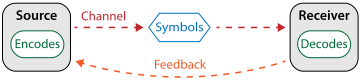
The communication process is composed of three interrelated elements:
- Source: The sender, speaker, or writer.
- Symbols: The words or gestures used.
- Receiver: The listener or reader.
Barriers to Effective Communication
Confusion Between the Symbol and Symbolized Object: Words and symbols might not carry the same meaning for everyone.
Overuse of Abstractions: Abstract terms may not elicit the intended images in listeners' minds. More concrete (specific) terms are preferred.
Interference (External Factors): Disruptions in the communication cycle can truncate or distort the message.
Types of interference:
- Physiological: Biological problems that inhibit symbol reception, such as hearing loss, injury, or physical illness.
- Environmental: External physical conditions, such as the noise level inside many small aircraft.
- Psychological: How the participants feel. For example, a lack of commitment inhibits the flow of information.
Lack of Common Experience: This is the greatest barrier to communication. Instructors should tailor their dialogue to match the varying experience levels of different pilots.
Developing Communication Skills
Instructors develop communication skills through:
- Role-playing.
- Effective listening and questioning techniques.
- Experience in actual instruction.
- Continued professional development.
Role-Playing Techniques
Role-playing provides aspiring instructors with experience in instructional communication. The instructor candidate assumes the teaching role, instructing their peers as if they were learners.
Listening Techniques
Hearing is a passive but constant process. Listening is an active process (hearing with comprehension).
Effective listeners:
- Take notes.
- Maintain eye contact.
- Listen for the main ideas.
- Guard against daydreaming.
- Listen to understand rather than refute.
Everyone has two ears, two eyes, and one mouth. They should be used in that order and proportion.
Guarding Against Daydreaming
Since most people can listen faster than someone can speak, listeners may start daydreaming. To counteract this, listeners can internally paraphrase or summarize what's being said, leading to better information retention.
Types of Listening
- Reactive: Reacting to an attention-grabbing sound, the most basic type of listening.
- Intensive: Listening for shades of meaning in words, used when learning a new language.
- Responsive: Listening for a response to a posed question.
- Selective: Sorting through the sounds being heard for main ideas.
- Extensive: Trying to understand the information being communicated.
- Interactive: Involves communicating and listening simultaneously.
Questioning Techniques
Effective questioning can determine how well the learner understands what is being taught. It also shows the learner that the instructor is paying attention and is interested in the response.
Question Types: An instructor should ask focused, open-ended questions ("why" or "how") and avoid closed-ended questions ("yes" or "no").
Preparation: Instructors should prepare relevant questions before each lesson and supplement them with spontaneous questions as the lesson unfolds.
Perception Checking
Perception checking is a questioning technique in which the receiver verifies the correct interpretation of a message, significantly reducing the risk of misunderstanding and conflict.
Perception checking has three steps:
- Restate the message (e.g., "When you said [...].").
- Provide two possible interpretations of the message (e.g., "I think you meant [...] or [...].").
- Request clarification (e.g., "Does that sound right?").
Instructional Communication
Instructional communication informs listeners during the teaching-learning process. This type of communication requires instructors to be knowledgeable about the subject matter and present content in an engaging, tailored way that meets learners' needs.
Suggestions to Enhance Instructional Communication
- Teach Familiar Subjects: Instructors should focus on topics they know well and feel confident teaching.
- Incorporate Personal Experiences: Using personal experiences can make instruction more relatable, but excessive anecdotes or "war stories" should be avoided.
- Clarify "How" and "Why": Instructors should explain not only the procedures but also the underlying principles and reasons behind them.
Instructional Enhancement
Instructional enhancement states that instructors' knowledge depth directly influences their confidence, engagement, and productivity in teaching. Aviation instructors can pursue professional development through seminars, membership in professional organizations, and online courses.
A good instructor never stops learning.
Risk Examples for the Fundamentals of Instructing
Recognizing and Accommodating Human Behavior
- Failure to recognize stress or anxiety can increase learner frustration; foster an open, supportive learning environment.
- Failure to accommodate differences among learners can reduce instructional effectiveness; adapt teaching methods to learners' needs.
Barriers to Communication
- Technical jargon can cause misunderstandings; use clear, simple language.
- Noise can inhibit communication; reduce background noise and verify understanding through feedback.