Steep Turns
What is a Steep Turn?
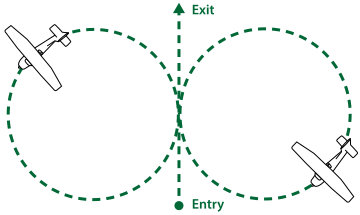
Steep turns consist of a single or multiple 360° turns in either or both directions, generally using a bank angle of 45° or 50° for training purposes. During the maneuver, pilots must maintain a constant altitude, airspeed, and bank angle.
When performing steep turns, pilots are exposed to:
- Higher load factors.
- The airplane's inherent overbanking tendency.
- The need for additional power to maintain airspeed.
- The need for substantial pitch control pressures to maintain the vertical component of lift.
The Need for Additional Power in a Steep Turn
As an airplane is banked, back pressure on the pitch control is applied to maintain level flight. The increase in lift results in more drag and a slower airspeed.
The turn also increases the load factor and stall speed. Power must be increased to overcome drag and maintain a margin above the stall speed.
| Load Factor | Drag | Stall Speed | Power Required |
|---|---|---|---|
| Increases | Increases | Increases | Increases |
Correcting for Left-Turning Tendencies
Torque and P-factor effects vary considerably throughout each phase of flight. Pilots must learn to compensate for these forces by using aileron and rudder inputs when appropriate.
During Left and Right Turns
- Greater rudder pressure is required when making right turns than when making left turns.
- The airplane tends to skid in left turns (less, or even slightly opposite, rudder pressure is required).
- The airplane tends to slip in right turns (slight right rudder pressure may be required throughout the turn).
Overbanking Tendency
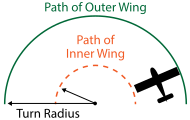
In a steeply-banked turn, airplanes tend to continue rolling in the direction of the bank unless deliberate, opposite aileron pressure is applied against the bank. The tendency to continue rolling is called overbanking.
Overbanking occurs due to differences in lift between the wings. The wing on the outside of the turn travels a longer path than the inside wing, yet both complete their respective paths in the same unit of time. Therefore, the outside wing travels at a faster airspeed than the inside wing, and, as a result, it develops more lift.
Maneuvering Speed
The design maneuvering speed (VA) is a structural design airspeed used to determine the strength requirements for the airplane and its control surfaces.
When at or below VA in smooth air, the pilot can fully deflect one flight control one time in a single axis without exceeding the applicable empennage or aileron design loads; however, a nose-up input may need to be reduced to avoid exceeding the airplane’s positive limit load factor.
Pilots should not interpret VA as:
- A speed that permits repeated or reversing full inputs in one axis or multiple full control inputs at the same time. Combined pitch and roll inputs can create rolling-G loads that exceed the airplane's structural limits.
- A gust penetration speed, although some manufacturers use it for that purpose. The AFM/POH may provide a separate turbulence penetration speed.
Effect of Weight on Maneuvering Speed
The maneuvering speed (VA or VO) published in the AFM/POH is valid for operation at the stated weight, typically the maximum gross weight. It decreases as the weight decreases.
Two concepts can explain the effect of weight on maneuvering speed:
- Newton's Second Law of Motion (F = MA)
- Its relationship to the angle of attack (turbulence and pull-ups)
Newton's Second Law of Motion (F = MA)
When an airplane is subjected to an aerodynamic force from a control input, it accelerates according to Newton's Second Law of Motion:
Acceleration = Force ÷ Mass
For a given aerodynamic force, acceleration increases as mass decreases. A lighter airplane therefore responds more rapidly to a control input and can develop structural loads more quickly. Consequently, maneuvering speed decreases as airplane weight decreases.
Angle of Attack (Turbulence and Pull-Ups)
Additional weight requires the aircraft to fly at a higher AOA to sustain flight. Since the heavier airplane is closer to the critical AOA (approximately 18°), it will stall more quickly after an abrupt pull-up or during turbulence. This leaves it less susceptible to excessive load factors than the lighter airplane.

Calculating Maneuvering Speed
If not specified in the AFM/POH, the maneuvering speed for a lower operating weight can be approximated with the following formula.
VA1 = VA2 × √(Current Weight ÷ Maximum Gross Weight)
- VA1 is the calculated maneuvering speed for the current weight.
- VA2 is the AFM/POH maneuvering speed at the maximum gross weight.
Load Factor
Load factor is the ratio of the total load supported by the airplane's wing to the total weight of the airplane.
Load Factor = Lift ÷ Weight
Effect of Turns on Load Factor
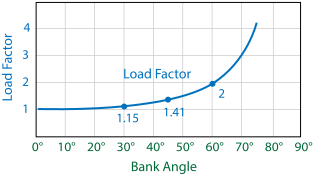
As an airplane is banked, more lift is required to maintain level flight because the lift vector is inclined. Total lift must increase to maintain the same vertical component of lift equal to the weight. Therefore, the load factor increases.
The following formula computes the load factor in a particular bank angle, represented by the Greek letter theta (Ø).
Load Factor = 1 ÷ cosØ
Factors Affecting Stall Speed
Load Factor
A stall that occurs at speeds greater than the 1 G stall speed is called an accelerated stall. In a constant-rate turn, load factors increase with bank angle. Pulling back on the pitch control also increases load factors.
An airplane's stall speed increases in proportion to the square root of the load factor.
Accelerated VS = VS × √(Load Factor)
| Bank | Load Factor | Stall Speed Increase |
|---|---|---|
| 0° | 1.0 G | 0% |
| 30° | 1.15 Gs | 7% |
| 45° | 1.41 Gs | 19% |
| 50° | 1.56 Gs | 25% |
| 60° | 2.0 Gs | 41% |
Turning Flight
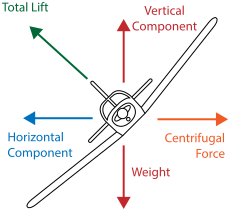
When the wings are banked, lift is separated into vertical and horizontal components. The horizontal component of lift causes the airplane to turn. Centrifugal force tries to pull the airplane away from the direction of the turn, counteracting the horizontal component of lift.
Lift and Drag in a Turn
Lift: The greater the bank, the greater the rate of turn will be because more lift goes into the horizontal component. Total lift remains constant because the vertical component decreases.
Drag: To maintain altitude in a turn, back pressure on the pitch control must be increased. As a result, drag increases, and additional power is needed to maintain airspeed.
Rate of Turn
The rate of turn is the number of degrees of heading change that an aircraft makes per second.
At a given airspeed, the turn rate increases if the bank angle increases. Likewise, if airspeed is held constant, the rate of turn increases as the bank angle increases.
Rate of Turn = (1,091 × tanØ) ÷ KTAS
Radius of Turn
At a given bank angle, a higher airspeed makes the turn radius larger because the airplane turns more slowly. The higher airspeed causes the aircraft to travel through a longer arc. To compensate for the increase in airspeed, the bank angle would need to be increased.
Radius of Turn = KTAS² ÷ (11.26 × tanØ)
How to Perform a Steep Turn
Pre-Maneuver Checks and Configuration
- Clear the area
- Heading established and noted:
- Select a suitable reference point on the horizon
- Align the heading bug, if equipped
- Altitude established:
- No lower than 1,500' AGL [ASEL]
- No lower than 3,000' AGL [AMEL]
- Position near a suitable emergency landing area and away from hazards
- Set power and aircraft configuration:
- Perform the clean (cruise) configuration flow
- Establish the recommended airspeed, or if not stated, an airspeed at or below VA or VO
Entry
- Note the pitch and power settings for use during the rollout.
- Smoothly and firmly apply aileron and rudder pressure in the direction of the desired turn.
- As the bank angle increases, apply back pressure to the pitch control to maintain level flight.
- Apply trim as desired to relieve control pressures.
- Add power as required to maintain airspeed.
Execution
- Maintain coordinated flight.
- Use the aileron to control the bank angle and counteract the overbanking tendency.
- Adjust power for airspeed deviations.
- Make small pitch and bank corrections for altitude deviations:
- If altitude decreases, momentarily reduce the bank angle by a few degrees.
- If altitude increases, momentarily increase the bank angle a few degrees.
Rollout
- Lead the rollout heading by approximately one-half the bank angle.
- Simultaneously level the pitch attitude and return power to the entry setting.
- Immediately roll into a turn in the opposite direction, if appropriate.
Exit
- Return to cruise attitude and airspeed.
- Retrim to relieve control pressures.
- Complete the cruise checklist.
Common Errors for Steep Turns
- Failure to scan for traffic before and during the maneuver
- Performing by reference to the flight instruments rather than visual references
- Inadequate pitch control on entry or rollout
- Failure to maintain a constant bank angle
- Gaining altitude in right turns and losing altitude in left turns when flown from the left seat
- Ineffective use of trim or power
- Rough or uncoordinated use of the flight controls
- Overcontrolling the airplane due to excessive or delayed flight control inputs
- Loss of orientation
- Failure to complete the turn on the designated heading or reference
Airman Certification Standards for Steep Turns
| Airspeed | Altitude | Bank | Rollout |
|---|---|---|---|
| ±10 KIAS | ±100' | 45° ±5° (SPT, PVT) 50° ±5° (COM, CFI) | ±10° |
Risk Examples for Flight Maneuver and Stall Training
Division of Attention Between Aircraft Control and Orientation
- Frequent changes in flightpath can cause loss of precise aircraft control; use smooth, coordinated control inputs.
- Fixation inside or outside the airplane can lead to loss of control or orientation; maintain a balanced scan between instruments and outside references.
Collision Hazards During Flight Maneuvers
- High-density training areas increase the likelihood of midair collisions; perform clearing turns and make radio calls.
- Conducting maneuvers near airways or arrival and departure routes increases collision risk; select training areas clear of known traffic flows and maintain an active traffic scan.
- Abrupt altitude changes during maneuvers increase the likelihood of midair collisions; perform clearing turns and make radio calls.
- Distractions while performing maneuvers increase the likelihood of midair collisions; minimize flight deck distractions and stay vigilant.
Low-Altitude Maneuvering, Including Stall, Spin, or CFIT
- Power lines, towers, and rapidly rising terrain increase the potential for CFIT; avoid unnecessary maneuvers near the ground.
- Lack of airspeed or altitude awareness can lead to inadvertent CFIT, stall, spin, or loss of control; increase focus and awareness as altitude or airspeed decreases.
Distractions, Task Prioritization, Loss of Situational Awareness, or Disorientation
- Distractions, poor task prioritization, loss of situational awareness, or disorientation can cause delayed, omitted, or incorrect actions; minimize nonessential tasks, prioritize "Aviate, Navigate, Communicate," and remain focused.
Uncoordinated Flight
- Improper or inadequate control inputs can cause uncoordinated stalls or spins; use smooth control inputs and monitor coordination.