What is a Spin?
Reference: AC 61-67
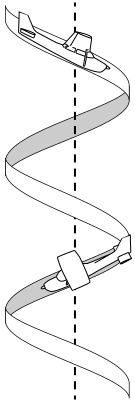
A spin is an aggravated stall that results in autorotation. The airplane remains stalled, descending rapidly in a helical path, rotating about a vertical axis. The spinning motion involves simultaneous rolling, yawing, and pitching.
A straight-wing aircraft’s spin is characterized primarily by the rolling motion with moderate yaw. The attitude of the spin is typically about 40° nose down.
Autorotation
A spin results in a steady rolling and yawing motion called an autorotation. This means the airplane continues to roll and yaw without any input from the pilot.
Autorotation results from an unequal AOA and unequal drag on the airplane’s wings. The outer (rising) wing has a decreasing AOA, where the relative lift increases and the drag decreases. Meanwhile, the inner (descending) wing has an increasing AOA, which reduces relative lift and increases drag.
In summary:
- The difference in lift causes the aircraft to continue rolling.
- The difference in drag causes the aircraft to continue yawing.
Causes of a Spin
A spin occurs when the airplane’s wings exceed their critical AOA with a sideslip or yaw acting on the airplane at or beyond the actual stall.
The yaw that causes a spin could be due to many factors, including:
- Incorrect rudder application
- Application of aileron when the wing is stalled, resulting in aileron drag (adverse yaw)
- Engine/propeller effects, including P-factor, torque, spiraling slipstream, and gyroscopic precession
- Wind shear, including wake turbulence
- One wing produces more lift due to ice contamination
- Asymmetrical thrust [AMEL]
How to Recognize a Spin Entry
The typical spin motion starts with a roll-off (yaw and roll) during the stall. The yawing and rolling motions begin as the nose drops. About the half-turn point, the airplane is pointed almost straight down. Airspeed remains low because the angle of attack is usually above that of the stall.
How to Prevent a Spin
The primary method of spin avoidance is stall avoidance. In a straight-wing aircraft, if a stall does not occur, a spin cannot occur.
If a stall does occur, maintaining directional control and not allowing the nose to yaw is key to averting a spin. The pilot must apply the correct amount of rudder to keep the nose from yawing and the wings from banking.
Direction of a Spin
A stall that occurs while the airplane is in a slipping or skidding turn can result in a spin entry and rotation in the direction of the rudder application (or other yaw force), regardless of which wingtip is raised.
Spins Due to Uncompensated Turning Tendencies
Since the left-turning tendency requires rudder pressure to maintain coordination in a climb, the airplane is likely to be yawing left as an unintentional stall occurs, and a left spin may follow.
Right Turn: For a departure stall in a right turn, the additional right rudder pressure necessary for coordination is apt to be missing. Although the stall occurs in a right turn, the uncompensated left-turning tendency will likely result in a left spin “over the top.”
Left Turn: If the stall occurs in a left turn, the ball/brick (slip-skid indicator) may not be as far to the right. The uncompensated left-turning tendency will likely result in a left spin “out the bottom.”
Angle of Attack in a Spin
Note: Not all spins require both wings to be stalled. Sometimes only one wing is stalled. Swept-wing aircraft may enter a spin without either wing being stalled.
In a spin, at least one of the wings is stalled, and their angles of attack are not equal.

Spin Entry: When an airplane stalls in uncoordinated flight, one wing drops, and the other rises. The downward-moving (inner) wing experiences an increased AOA, and the upward-moving (outer) wing decreases in AOA. This motion furthers the lift imbalance of the wings, increasing the low wing’s tendency to drop.
Established Spin: The airplane continues to roll and yaw in a stabilized spin, causing the outer wing to move forward through the air faster. The upward and faster-moving (outer) wing has a lower AOA than the inner wing. The outer wing’s decreased AOA results in more lift and less drag.
| Inner (Downward) Wing | Outer (Upward) Wing |
| Higher AOA, more stalled | Lower AOA, less stalled |
| Less lift | More lift |
| More drag | Less drag |
Load Factor in a Spin
The load factor during a spin varies with the spin characteristics of each aircraft but is usually slightly above 1 G.
There are two reasons for this:
- Airspeed in a spin is very low, usually within 2 knots of the stall speed.
- An airplane in a spin pivots rather than turns.
The load factor in a proper spin recovery is about 2.5 Gs.
Instrument Indications in a Spin
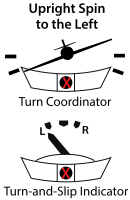
Airspeed Indicator: Airspeed should be near or below stall speed. Fluctuations can be expected due to variations in airflow around the pitot tube.
Inclinometer, Attitude Indicator, and Heading Indicator: Unreliable.
Electronic Flight Instruments: Electronic flight instruments are less susceptible to tumbling. The turn rate indicator, generally at the top of the Horizontal Situation Indicator (HSI) compass card, shows the rate and direction of the turn. The HSI compass card rotates in the opposite direction of the turn indicator.
Turn Coordinator: The symbolic airplane on the turn coordinator reacts to both roll and yaw. It is only reliable in upright spins where both roll and yaw are in the same direction. Rudder pressure should be applied toward the high wing, opposite the direction the symbolic airplane is turning.
Turn-and-Slip Indicator: The turn needle reacts only to yaw and is, therefore, reliable in upright and inverted spins. Rudder pressure should be applied opposite the direction that the turn needle is deflected.
Events that Lead to Inadvertent Spins
Skidding Turn on to Final: Consider a late turn on to final approach, overturning the centerline, particularly on a glide or forced-landing approach or in a crosswind. If an attempt is made to correct the situation by increasing rudder pressure in the turn direction without increasing the bank, all of the ingredients needed to start a spin are present.
Low-Speed Climbing Turns: The aircraft is already vulnerable by being at low speed and in a nose-up attitude. Airspeed will diminish if this is not compensated for by lowering the nose. Aileron inputs may give the required yaw to precipitate the spin.
False Visual Horizons: Flying in hilly terrain may distort the visual cues needed to ascertain the aircraft’s pitch and roll attitudes. It is easy to allow airspeed to reduce further than anticipated. When combined with a turn, particularly in confined areas, this can produce stall and yaw, the two components needed for a spin.
Engine Failure After Liftoff: In a climb pitch attitude without power, the airplane is near the stalling AOA. At the same time, the pilot may still be holding right rudder pressure. The pilot must immediately lower the nose to prevent a stall while releasing rudder pressure to maintain coordinated flight.
“Impossible” Turn: Attempting a turn back to the runway after an engine failure increases G loading and the stall speed. Any yaw could put the airplane into the incipient spin situation.
Spin Phases
Reference: AC 61-67
Entry
The entry phase is where the pilot provides the necessary elements for the spin, either accidentally or intentionally.
Incipient Stage
The incipient phase is from the time the airplane stalls and rotation starts until the spin has fully developed. In small airplanes, this change may take up to two turns and lasts about 4–6 seconds.
Developed Phase
In the developed phase, the spin is in equilibrium. The rotation rate, airspeed, and vertical speed are stabilized while in a flightpath that is nearly vertical.
As a rough estimate, an altitude loss of approximately 500′ for every 3 seconds of turn or descent rates of 10,000 FPM can be expected. Greater losses can occur at higher-density altitudes.
Recovery Stage
The recovery phase begins when the wings’ AOA decreases below the critical AOA and autorotation slows. Spinning ceases when the opposing forces overcome the autorotation.
Spin recovery is not instantaneous. It may take several turns for the antispin control inputs to overcome pro-spin forces. The longer an aircraft is in a spin, the more turns it may take to recover.
During the recovery phase, the nose attitude typically steepens, and the rotation rate may momentarily accelerate, giving the impression that the spin is getting worse. The antispin control inputs must be maintained until the spin stops.
How to Recover from a Spin
Reference: AC 61-67
There is no universal spin-recovery technique that works for all aircraft. The aircraft’s particular spin characteristics are listed in the AFM/POH. In the absence of the manufacturer’s recommended spin recovery procedures and techniques, the “PARE” recovery procedure is recommended.
Power (Throttle) to Idle
- Power aggravates spin characteristics, usually resulting in a flatter spin attitude and increased rotation rate.
Ailerons to Neutral
- Aileron control in the direction of the spin may increase the rotation rate and delay recovery.
- Aileron control opposite the spin’s direction may cause flattening of the spin attitude and delayed recovery or may even be responsible for causing an unrecoverable spin.
- The best procedure is to ensure that the ailerons are neutral.
Rudder Against the Rotation
- Apply full opposite rudder (against the stop).
- After the rotation stops, neutralize the rudder.
Elevator (or Stabilator) Control Forward of Neutral to Break the Stall
- Immediately after full rudder application, briskly move the elevator to decrease the excessive AOA and break the stall. Hold the controls firmly in this position.
- When the stall is “broken,” the spinning stops.
- Avoid a secondary stall by not applying excessive back pressure on the pitch control.
Safety Considerations
- Slow and overly cautious control movements during spin recovery must be avoided. Brisk movements result in a more positive spin recovery.
- Care should be taken not to exceed structural limits and airspeed limitations.
- If the flaps or retractable landing gear are extended, they should be retracted as soon as possible after entering a spin.
Flat Spins
In a flat spin, both wings end up at highly stalled AOAs. The aircraft’s attitude is about level with the horizon, and it lacks the roll and pitch oscillations of a conventional spin. Instead, it consists almost entirely of yaw about the vertical axis.
Flat spins rotate more slowly than upright spins, but they appear to be turning much faster to the pilot. That’s because the pilot’s line of sight is parallel to the horizon, allowing him or her to see much more going past. The rate of altitude loss per turn is generally less than in a steep nose-down spin.
Except for some specialized aerobatic aircraft, flat spins may be unrecoverable. Recovery requires the nose to be forced down, increasing the rotation rate in the initial stages, which can be disconcerting.
Most GA aircraft have design features that preclude a flat spin, but not all. Those prone to unintentional flat spins are likely to have an annotation in the AFM/POH that spins are not authorized.
Spiral Dives
Spiral dives are steep, descending turns that become progressively tighter over time. Unlike a spin, airspeed and G-forces rapidly increase because the airplane is no longer stalled.
Spiral dives most commonly result from:
- Botched spin entries.
- Inadvertent VFR flight into IMC.
Spiral Dive Recovery Procedures
A spiral dive recovery is essentially the same procedure used to recover from a nose-low, unusual attitude.
- Disengage the autopilot, if equipped.
- Immediately reduce power to idle to slow the rate of acceleration.
- Before rolling the wings level, apply some forward elevator control pressure to reduce the G-load on the airplane (“unload the wing”). Return to about 1 G.
- Roll the wings level using coordinated aileron and rudder inputs.
- Gently raise the nose to a level flight attitude. Do not “pull and bank” simultaneously.
- Return to level flight.
Caution: The design limit of the airplane is lower during a rolling pullout, so failure to reduce the G-load before rolling the wings level could result in structural damage or failure.
Common Errors in the Recovery from Spiral Dives
- Failure to reduce power or mistakenly adding power
- Attempting to recover from the dive before rolling the wings level
- Failure to unload the airplane before rolling wings level
- Failure to add power once a climb is established
Weight and Balance Related to Spins
Airplanes operated in the utility category have greater weight and balance restrictions than in the normal category. In the normal category, an airplane may have less resistance to spin entry due to its ability to generate a higher AOA and load factor.
An airplane approved for spins in the utility category but loaded in the normal category may not recover from a spin that has progressed beyond the incipient phase.
Center of Gravity Location
With a forward CG, the airplane flies at a higher AOA and stalls at a higher indicated airspeed due to increased wing loading. However, the nose wants to pitch down during a stall, aiding in the recovery from a stall or spin.
With an aft CG, wing loading is decreased. This lowers the indicated stall speed but makes a recovery from a spin harder because the airplane loses its tendency to pitch down. This may result in a flat spin, and recovery may be impossible.
| Forward CG | Rearward CG |
| Faster stall speed | Slower stall speed |
| Nose heavy, easier spin recovery | Tail heavy, difficult spin recovery |
Aircraft Certification Requirements for Spins
Reference: 14 CFR 23.2150
Current Certification Rules
Single-engine airplanes that are not certified for aerobatics must not tend to depart controlled flight inadvertently. The ability to recover from a spin is not a certification requirement, but the airplane is designed with an equivalent level of safety (ELOS). For example, more effective stall warning devices, ballistic parachutes, or increased resistance to departure from controlled flight could be used by manufacturers to comply with certification rules.
Levels 1 and 2 multi-engine airplanes that are not certified for aerobatics must not tend to inadvertently depart controlled flight from thrust asymmetry after a critical loss of thrust.
All airplanes certified for aerobatics that include spins must have controllable stall characteristics and the ability to recover within one and one-half additional turns after initiation of the first control action from any point in a spin, not exceeding six turns or any greater number of turns for which certification is requested, while remaining within the operating limitations of the airplane. They must recover from spins without exceeding limitations and may not develop unrecoverable spins.
Note: After the 14 CFR Part 23 rewrite, only aerobatic airplanes can be certified to conduct spins.
Historical Certification Rules
Note: The certification of normal category single-engine airplanes previously occurred under 14 CFR 23.221. The rule still applies to aircraft certified under that regulation.
Normal category airplanes were not certified to perform acrobatic maneuvers, including spins. However, to provide a margin of safety when recovery from a stall is delayed, they were tested during certification and demonstrated the ability to recover from a one-turn spin or a three-second spin, whichever takes longer, in not more than one additional turn. Their performance characteristics beyond these limits are unknown, and there is no assurance that recovery from a fully developed spin is possible.
Acrobatic category airplanes had to meet the spin certification requirements of normal category airplanes. They must have also demonstrated the ability to recover from any point in a spin, up to and including six turns, or any greater number of turns for which certification is requested, in no more than one and a half additional turns after initiation of the first control action for recovery.
Utility category airplanes had to meet the spin certification requirements of normal category airplanes. When approved for spins, the airplane must have also met the spin certification requirements for acrobatic category airplanes.
Placard Requirements for Spins
Airplanes type-certificated under 14 CFR Part 23 must have all placards in clear view of the pilot. The Airplane Flight Manual lists the required placards.
Standard placard wording:
- Normal Category Airplanes: “NO ACROBATIC MANEUVERS INCLUDING SPINS APPROVED”
- Utility Category Airplanes that Meet Spin Requirements: “Acrobatic maneuvers are limited to the following: [list approved maneuvers and the recommended entry speed for each]”
- Utility Category Airplanes that Do Not Meet Spin Requirements: “SPINS PROHIBITED”
Spin Recovery Training
References: 14 CFR 91.303, 14 CFR 91.307, Finagin (2012) Legal Interpretation, Fitzpatrick (2018) Legal Interpretation
Note: The following procedures are generalized. Procedures, including immediate-action items, must be accomplished as detailed in the AFM/POH and the appropriate checklist.
The purpose of training instructor applicants is to teach them to recognize and recover from unintentional spins. Understanding spins also increases confidence and helps to reduce the anxiety associated with spins.
Aircraft Approved for Spins
Official sources for determining if spins are approved for a specific airplane:
- Type Certificate Data Sheet (TCDS)
- The limitations section of the AFM/POH
- For light-sport and experimental aircraft, the operating limitations supplied with the airworthiness certificate
- A placard located in clear view of the pilot
The limitations section of the AFM/POH may provide additional specific requirements for spin authorization, such as limiting gross weight, CG range, and fuel amount.
Intentional spins are never approved when operating in the normal category. They may be approved in some cases when operating in the utility category (consult the AFM/POH).
Preflight Considerations
- During preflight planning, special emphasis should be placed on the weight and balance of the airplane.
- Loose items should be secured or removed from the airplane during the preflight inspection.
Applicable Regulations
- Parachutes are not required by 14 CFR 91.307 to conduct spins and other flight maneuvers required by the regulations for any certificate or rating when given by a CFI or ATP.
- Aerobatic flight restrictions outlined in 14 CFR 91.303 do apply.
Anticipated Altitude Loss in a Spin
- The first turn in a spin results in an altitude loss of approximately 1,000′.
- Each subsequent turn loses about 500′.
- It generally takes 1,200′ to recover from a one-turn spin.
Recovery Point
Incipient spins that are not allowed to develop into a steady-state spin are most commonly used in spin 43covery training. Recovery procedures should begin before completing 360° of rotation.
In some aircraft, recovery may not be possible if the spin progresses to the developed stage. Therefore, recovery must be initiated at the first sign of a spin.
Procedure
Note: The “PARE checklist” is a general spin recovery procedure. Procedures published by the manufacturer have precedence.
- Begin by practicing both power-on and power-off stalls to familiarize the applicant with the aircraft’s stall characteristics.
- Before initiating the maneuver, the area must be cleared of other traffic. Proper visual scanning techniques must be followed.
- Unless the aircraft manufacturer recommends a higher altitude, establish an entry altitude that will allow the recovery to be completed above 1,500′ AGL. The minimum recommended altitude is 3,500′ AGL.
- Apply the entry procedure for a power-off stall with the airplane in a clean configuration. As the airplane approaches the stall, smoothly apply full rudder pressure in the desired spin direction and apply back-elevator pressure to the limit of travel. The ailerons should remain neutral.
- Allow the spin to develop and fully recover within one full turn. Observe the airspeed indicator during the spin and subsequent recovery to ensure that it does not reach the red line (VNE).
- If a spin is not fully developed, the aircraft may instead go into a steep spiral. A spiral may be recognized by a rapidly increasing airspeed after the attempted spin entry.
Common Errors for Spin Recovery Training
Spin Entry:
- Failure to scan for traffic before the maneuver
- Failure to close the throttle when a spin entry is achieved
- Failure to apply full rudder pressure to the stops in the desired spin direction during spin entry
- Failure to apply and maintain full up-elevator pressure during spin entry, resulting in a spiral
- Failure to achieve a fully stalled condition before spin entry
Spin Recovery:
- Failure to apply full rudder pressure to the stops against the spin during recovery
- Failure to apply sufficient forward-elevator pressure during recovery
- Waiting for the rotation to stop before applying forward-elevator pressure
- Failure to neutralize the rudder after rotation stops, possibly resulting in a secondary spin
- Slow or overly cautious control movements during recovery
- Excessive back-elevator pressure after rotation stops, possibly resulting in a secondary stall
“Falling Leaf” Demonstration Stall
Note: This demonstration is for stall and spin awareness purposes. Its performance is not a requirement for any pilot certificate or rating.
A “falling leaf” stall can be demonstrated and practiced to develop the pilot’s ability to control the airplane during a stall. With the airplane held in a fully stalled condition, rudder inputs alone are made to correct for deviations in yaw and roll. The airplane continually slips in a side-to-side motion as it drifts toward the ground, resembling a leaf falling through the air.
A “falling leaf” stall teaches the learner:
- How to prevent the airplane from entering into a spin.
- How unstable the airplane becomes in a stalled condition.
- The importance of reducing the AOA to recover from a stall.
- Why it is important to use the rudder and not the ailerons during a stall recovery.
- The airplane still flies during a stall, but the wings do not generate enough lift to keep the airplane level.
How to Perform a “Falling Leaf” Stall

- Use the pre-maneuver checks and entry procedures of a power-off stall in a clean configuration.
- Enter into a straight-ahead, full stall.
- Instead of initiating a stall recovery, maintain back-elevator pressure to keep the airplane beyond the critical AOA.
- Keep wings level using the rudder. Avoid overcorrecting.
- Briefly deflect the ailerons to demonstrate how sluggish and unresponsive they are.
- Initiate the stall recovery by reducing back pressure and decreasing the AOA. Note that the airplane instantly becomes more stable.
- Return to level, cruise flight recovery procedures of a power-off stall.
Human Factor Considerations for Spins
Disorientation
Disorientation occurs when there is a conflict between the visual and vestibular sensations. During the initial stages of a spin, the eyes can help the pilot remain oriented. However, disorientation often occurs beyond two turns.
Disorientation can also occur when a spin abruptly stops because the fluid within the semicircular canals continues to move. The brain must contend with a conflict between a feeling of turning and a visual indication of no actual rotation.
Anxiety During Spin Training
Anxiety is a feeling of worry, nervousness, or unease, often about something that will happen with an uncertain outcome.
Instructors can reduce a learner’s anxiety as it relates to spin training by:
- Treating fears as a normal reaction rather than ignoring them.
- Describing the physical sensations to be expected.
- Ensuring that learners know the training exceptions.